Definition
of Cheque Truncation:
- Truncation is the process in which an issued cheque is not moved physically from the drawer bank branch to the drawee bank branch. Instead an electronic image of the cheque is sent to the drawee branch through the clearing house along with relevant information like data on the MICR band, date of presentation, presenting bank, etc.
- Cheque truncation thus eliminates the requirement of physically moving documents across bank branches except unavoidable circumstances. This effectively eliminates the associated cost of movement of the physical cheques, reduces the time required for their collection and brings elegance to the entire activity of cheque processing.
- RBI decided to prescribe certain benchmarks towards achieving standardisation of cheques known as “CTS-2010 standard”, specifications.
Role of NPCI:
- RBI has mandated NPCI to operationalise CTS. NPCI will act as a Cheque Processing Centre (CPC) and will process electronic cheques and images received from member banks
Mandatory features applicable:
- Paper: Paper should have protection against alterations by having chemical sensitivity to acids, alkalis, bleaches and solvents giving a visible result after a fraudulent attack. CTS-2010 Standard paper should not glow under Ultra-Violet (UV) light i.e., it should be UV dull.
- Watermark: All cheques shall carry a standardized watermark, with the words “CTS-INDIA”. It should be oval in shape and diameter could be 2.6 to 3.0 cms. Each cheque must hold atleast one full watermark.
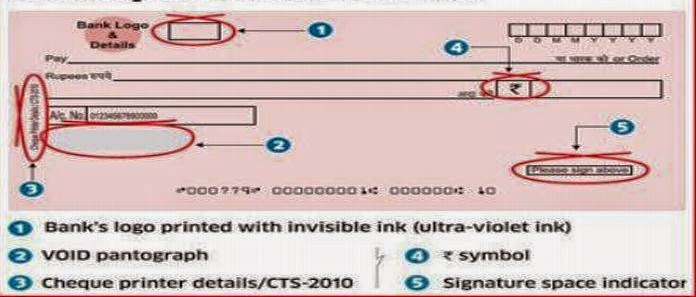
- VOID pantograph: Pantograph with hidden / embedded “COPY” or “VOID” feature shall be included in the cheques. This feature should be clearly visible in photocopies and scanned colour images as a deterrent against colour photocopy or scanned colour images of a cheque.
- Bank’s logo: Member Bank’s logo shall be printed in ultraviolet (UV) ink. The logo will be captured by / visible in UV-enabled scanners / lamps. It will establish genuineness of a cheque.
- Mandating colours and background: Light / Pastel colours so that Print / Dynamic Contrast Ratio (PCR / DCR) is more than 60% for ensuring better quality and content of images.
- Prohibiting alterations / corrections on cheques: No changes / corrections should be carried out on the CTS cheques (other than for date validation purposes, if required). For any change in the payee’s name, courtesy amount or legal amount etc., fresh cheque forms should be used by customers. This requirement is for cheques issued under CTS only and no other cheques.
- Printing of account field: Cheques used in current accounts and corporate customers, should be issued with the account number field pre-printed. Courtesy amount means amount in figures and legal amount means in words.
Importance
of CTS:
- Speeds up the process of collection of cheques resulting in better service to customers
- Reduces the scope for clearing-related frauds or loss of instruments in transit
- Lowers the cost of collection of cheques
- Removes reconciliation-related and logistics-related problems
- The homogeneity in security features also act as a deterrent against cheque frauds.
Clearing Methods:
- Speed Clearing is an arrangement to clear intercity non-at par items.
- Grid Clearing is an arrangement that allows banks to present/receive cheques from/to multiple cities in a Single Clearing House through a service branch at one city.
What
benefit does CTS provide to Bank's Customers?
- It reduces the time taken to clear the cheques as well gives banks to offer better customer services and increases operational efficiency by decreasing on overheads involved in the physical cheque clearing process which was used earlier.
- It also provides better reconciliation and fraud prevention.
Source: RBI, IBA, Economic Times, Moneycontrol, The Hindu
Spread the word, share it with friends.
Regards
Team ExamPundit