Hello and welcome to ExamPundit. Here is a set of Reasoning Quiz for the upcoming SBI PO Prelims on 27th June focus on inward-outward seating arrangements problems.
function answer(id){ if(document.getElementById(id).style.display == "block"){ document.getElementById(id).style.display = "none"; }else{ document.getElementById(id).style.display = "block"; } } #a1{display:none;} #a2{display:none;} #a3{display:none;} #a4{display:none;} #a5{display:none;} #a6{display:none;} #a7{display:none;} #a8{display:none;}
Directions (1 - 3):
Study the following information and answer the questions given below:
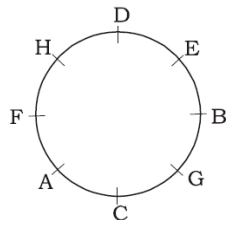
Eight friends—A, B, C,
D, E, F, G and H—are sitting around a circular table not necessarily in the same
order. Three of them are facing outward while five are facing towards the
centre. There are equal number of males and females in The group. C is facing
the centre. E is sitting third to the right of C. F is sitting third to the
left of E. Three persons are sitting between F and B. The immediate neighbours
of B are females. G is sitting third to the right of F. D is sitting third to
the right of A. A is not an immediate neighbour of E. The immediate neighbours
of E are males and are facing the centre. The immediate neighbours of D are females
and face outside. The one sitting third to the left of B is a male. No female
is an immediate neighbour of G.
1. Who is sitting
second to the right of E?
(a) C
(b) B
(c) G
(d) H
(e) None of these
2. How many persons
are sitting between H and C when counted from the left side of H?
(a) One
(b) Two
(c) Three
(d) Four
(e) More than four
3. Which of the
following statements is true regarding H?
(a) The one who is second to the right of H is a female.
(b) H is facing the centre.
(c) H is a male.
(d) The immediate neighbours of H are facing outside.
(e) None is true
Directions (Q. 4-8): In these questions, relationship between elements is shown in the
Statements. The Statements are followed by Conclusions I & II. Give answer:
(a) if only Conclusion I is true.
(b) if only Conclusion II is true.
(c) if either Conclusion I or II is true.
(d) if neither Conclusion I nor II is true.
(e) if both Conclusions I and II are true.
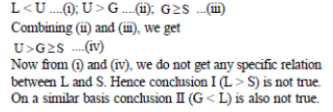
4. Statements: L
< U, U > G, G ≥ S
Conclusions: I. L > S II. G
< L
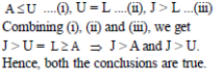
5. Statements: A ≤ U, U = L, L < J
Conclusions: I. J > A II.
J > U
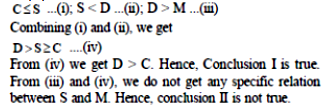
6. Statements: C ≤ S, S < D, D > M
Conclusions: I. D > C II. S > M
7. Statements: Y < G, G ≥ H, H = R
Conclusions: I. R = G II.
R < G
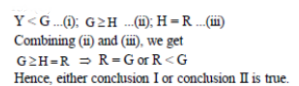
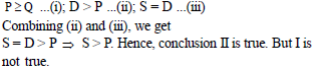
8. Statements: P
≥ Q, D > P, S = D
Conclusions: I. S= P II.
S > P
Regards
Team ExamPundit
Sponsored
(adsbygoogle = window.adsbygoogle || []).push({});
Books For 2015 Banking/Insurance Exams