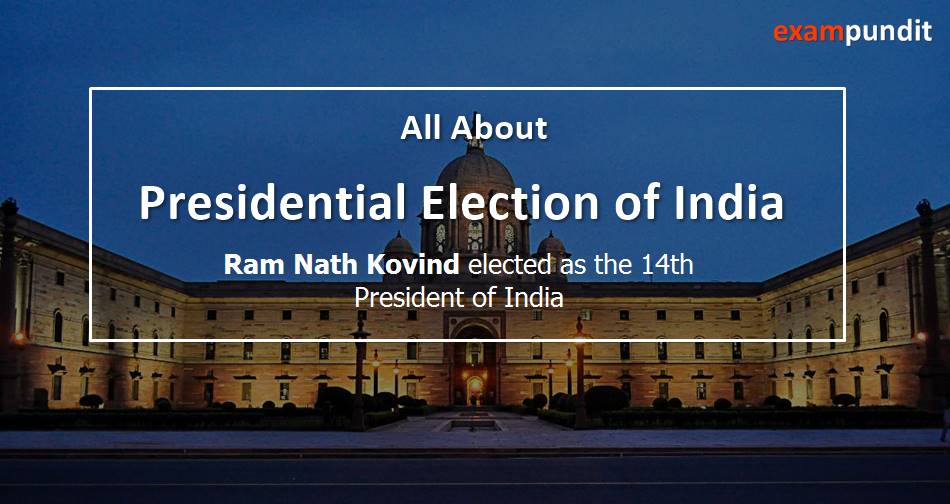
Hello and welcome to exampundit. NDA candidate Ram Nath Kovind has been elected the country's 14th president. Former governor of Bihar, Kovind (71), will be only the second Dalit leader after RK Narayanan since Independence to occupy India's highest ceremonial post.
In the final vote count, NDA
nominee Kovind received 65.6 per cent votes translating into 702,044 electoral
college votes, while UPA candidate Meira Kumar managed to get 34.35 per cent
(367,314 votes). According to reports, there was cross voting in UP, Gujarat
and Goa during the elections, which resulted into Kovind's massive 2/3rd votes.
522 MPs voted for Kovind, while
225 parliamentarians voted for Meira Kumar.
Current President Pranab
Mukherjee's term is ending on July 24 and Kovind will take oath the next day to
become India's 14th President.
Here is a short note on the Presidential Election of India.
Here is a short note on the Presidential Election of India.
2017 Presidential Election
Candidates:
Ram Nath Kovind - 14th President Elect
35th Governor of Bihar
(2015–2017)
Member of the Rajya Sabha from
Uttar Pradesh (1994–2006)
Meira Kumar
15th Speaker of the Lok Sabha
(2009–2015)
Member of the Indian Parliament
for Sasaram (Bihar) (2004–2014)
Article 58 of the Constitution
sets the principle qualifications one must meet to be eligible to the office of
the President. A President must be:
- a citizen of India
- of 35 years of age or above
- qualified to become a member of the Lok Sabha
- A person shall not be eligible for election as President if he holds any office of profit under the Government of India or the Government of any State or under any local or other authority subject to the control of any of the said Governments.
The security deposit for the
election is Rs. 15,000/- which will be required to be made along with the
nomination paper.
Certain office-holders, however,
are permitted to stand as Presidential candidates. These are:
- The current Vice-President
- The Governor of any state
- A Minister of the Union or of any state (including Prime Minister and Chief Ministers)
In the event that the Vice-President,
a State Governor or a Minister is elected President, they are considered to
have vacated their previous office on the date they begin serving as President.
A member of Parliament or of a
State Legislature can seek election to the office of the President but if he is
elected as President, he shall be deemed to have vacated his seat in Parliament
or State Legislature on the date on which he enters upon his office as President
[Article 59(1)].
Article 57 provides that a person
who holds, or who has held, office as President shall, subject to the other
provisions of this Constitution, be eligible for re-election to that office.
Under The Presidential and
Vice-Presidential Elections Act, 1952, a candidate to be nominated for the
office of president needs 50 electors as proposers and 50 electors as seconders
for his name to appear on the ballot.
Article 56(1) of the Constitution
provides that the President shall hold office for a term of five years from the
date on which he enters upon his office. According to Article 62, an election
to fill a vacancy caused by the expiration of the term of office of President
shall be completed before the expiration of the term.
Supreme Court shall inquire and
decide regarding all doubts and disputes arising out of or in connection with
the election of a President per Article 71(1) of the constitution. Supreme
Court can remove the president for the electoral malpractices or upon being not
eligible to be Lok Sabha member under the Representation of the People Act,
1951.
Sponsored
(adsbygoogle = window.adsbygoogle || []).push({});
Electoral College
The President is indirectly
elected by means of an electoral college consisting the elected members of the
Parliament of India and the Legislative assemblies of the States and the Union
Territories of Delhi and Puducherry and Vice President of India by an electoral
college consisting of members of both houses of parliament.
The number and value of votes are
based on the population in 1971 rather than the current population, as a result
of the 42nd Amendment, and extended by the 84th Amendment, with the intention
to encourage family planning programs in the states by ensuring that states are
not penalized for lowering their population growth.
The value of votes cast by
elected members of the state legislative assemblies and both houses of
parliament are determined by the provisions of article 55(2) of the
Constitution of India.
The Electoral College is made up of the following:
- elected members of the Rajya sabha (upper house of the Parliament of India);
- elected members of the Lok Sabha (lower house of the Parliament of India);
- elected members of each state Vidhan Sabha (lower house of the state legislature); and
- elected members of each union territory possessing an assembly (i.e., Delhi and Puducherry)
The formula for determining the
number of votes held by an MLA is:

Uttar Pradesh MLAs has the
highest value of vote.
The value of an MP's vote is
calculated by dividing the total value of all MLAs' votes by the number of MPs.
The formula for determining the number of votes held by an MP is:

Facts on President’s residence,
vehicle:
- Rashtrapati Bhavan, the President's official residence, is the largest Presidential Palace in the world.
- The Rashtrapati Nilayam at Bolarum, Hyderabad and Retreat Building at Chharabra, Shimla are the official Retreat Residences of the President of India.
- The official state car of the President is a custom-built heavily armoured Mercedes Benz S600 (W221) Pullman Guard.'
- Air India One is the call sign of any aircraft carrying the President. The aircraft are operated as VIP flights by the Indian Air Force.
Get a Free Mock Test for IBPS RRB - Click to Take Free Mock
ep Recommended Test Series
Sponsored
(adsbygoogle = window.adsbygoogle || []).push({});
Regards
Team ExamPundit